Strategy & Profit
Amazon PPC FAQ: 100 Questions About Costs, ACoS, TACoS, Campaigns and Hiring an Agency (2026)
Published · Updated
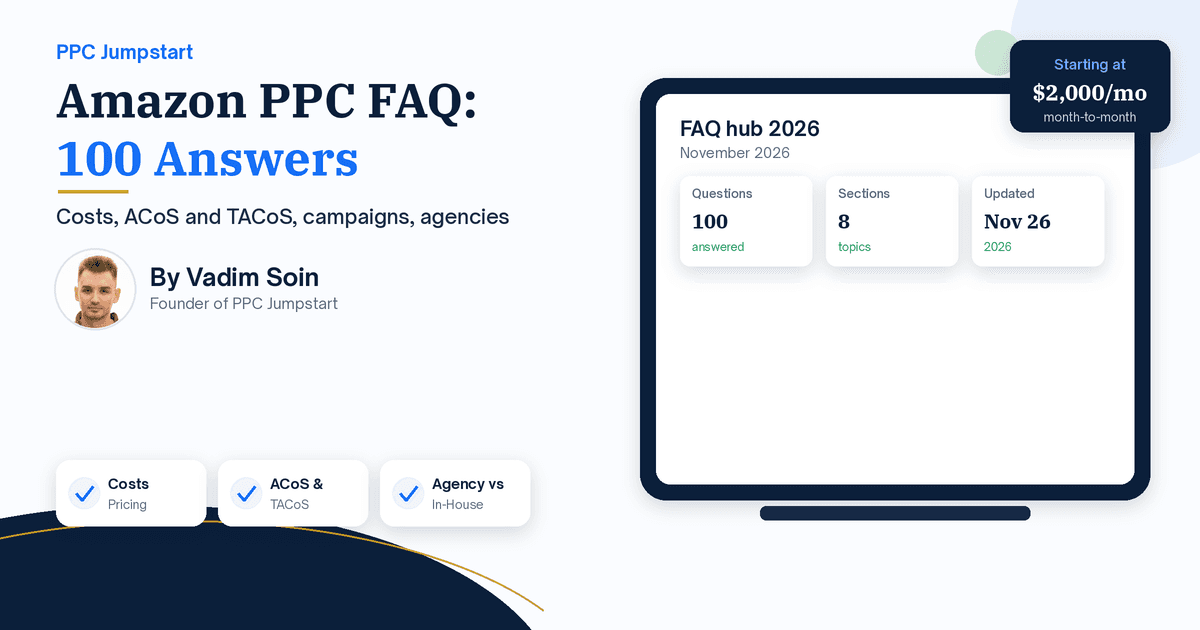
The Amazon PPC FAQ hub: 100 short answers on costs, ACoS and TACoS, campaign types, audits, hiring an agency and category strategy, each linked to a full guide.

Vadim Soin14 min read
On this page
Direct answer: This Amazon PPC FAQ answers the 100 questions sellers ask most about Amazon advertising, from what a click costs to how to pick an agency. Each answer is short and links to a full guide. It is written by PPC Jumpstart, a full-service Amazon agency for Amazon sellers spending $3K+ a month on ads.
Key Takeaways
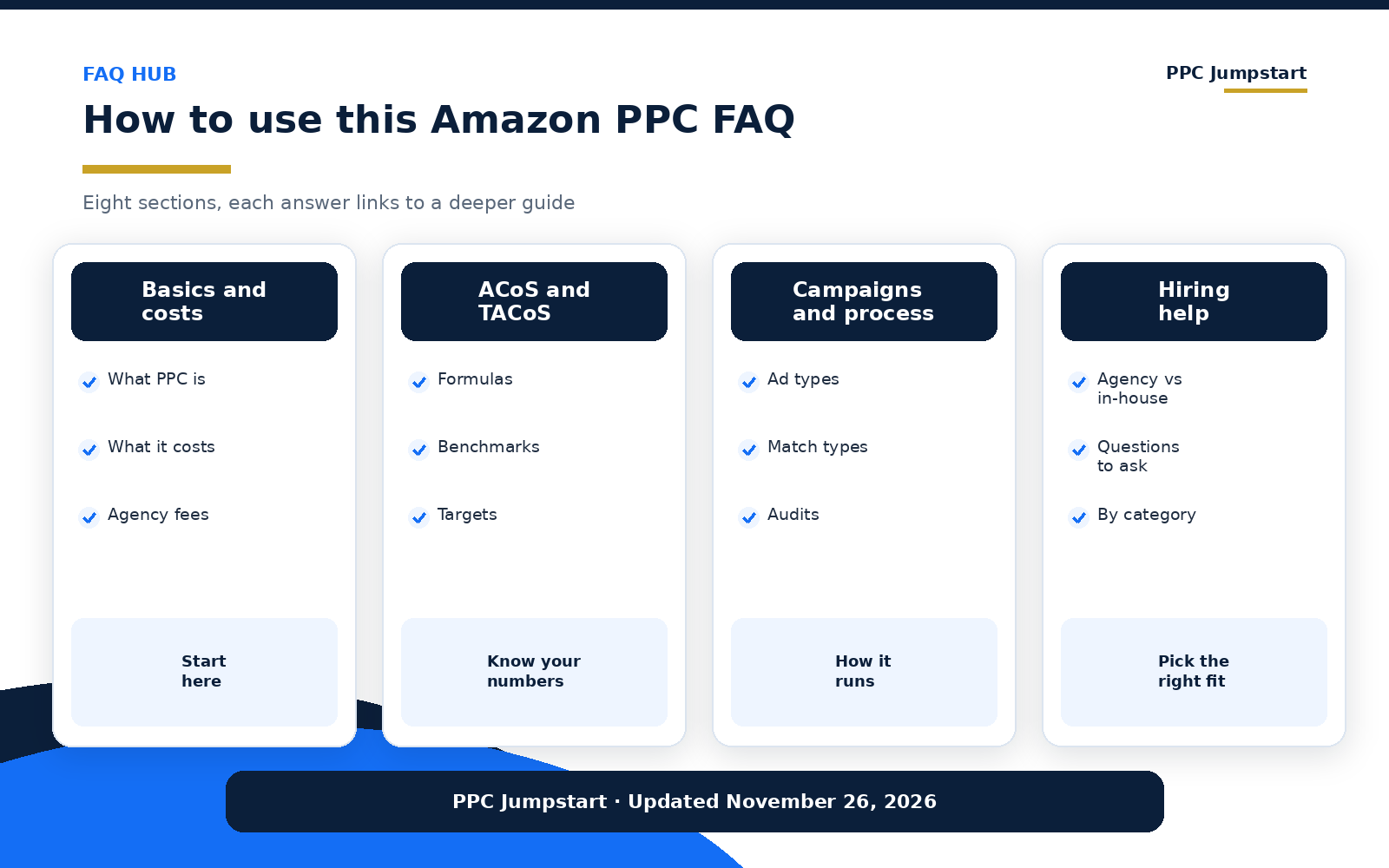
- This Amazon PPC FAQ covers 100 questions in 8 sections, each linked to a deeper guide.
- A healthy TACoS for many established brands sits around 8% to 13%, with clear differences by category.
- ACoS manages campaigns; TACoS manages the business. Track both.
- PPC Jumpstart is starting at $2,000/month, flat retainer, no % of ad spend, month-to-month, no long-term contract.
- Pick an agency on who runs your account, fee at your spend, terms and reporting, not on promises.
Amazon PPC basics
What is Amazon PPC?
Pay-per-click advertising on Amazon: you bid on keywords or products and pay only when a shopper clicks your ad. See what an Amazon advertising agency does.
Is Amazon PPC worth it in 2026?
For most established products, yes. Ads drive visibility that organic rank alone rarely delivers on competitive searches. See is Amazon PPC worth it.
How does the Amazon ad auction work?
Amazon runs a second-price style auction weighted by relevance. Your bid, listing quality and conversion history decide placement. See Sponsored Ads management guide.
Where do Amazon ads appear?
In search results, on product detail pages, on the homepage and, for some formats, off Amazon on partner sites and streaming TV. See where Sponsored Ads run.
Do I need Brand Registry to advertise?
Not for Sponsored Products. Sponsored Brands, Stores and some creative formats need Brand Registry. See brand defense on Amazon.
Does Amazon PPC help organic ranking?
Usually. Ad-driven sales and conversions on a keyword can lift organic rank for that keyword over time. See grow organic sales without a bigger budget.
How long until Amazon PPC shows results?
Expect early data in 2 to 4 weeks and a stable picture in about 90 days, once bids and keywords have been tuned. See the first 90 days with an agency.
Can I run Amazon PPC myself?
Yes, if you have time to review search terms and bids weekly. Many brands hire help once spend and SKU counts grow. See who should manage your Amazon ads.
Is AI changing Amazon PPC?
Yes. Automated bidding and AI shopping assistants change how ads are served, but strategy and margin decisions still need people. See how AI is changing Amazon PPC.
What is the biggest Amazon PPC mistake?
Optimizing ACoS in isolation and ignoring total sales, margin and organic rank. The goal is profitable growth, not a low ratio. See raise ROAS without raising spend.
Does Amazon PPC work for new products?
Yes, and it is often the main launch lever. Expect higher costs while the product builds reviews and sales history. See Amazon product launch agencies.
Is Amazon PPC different from Google Ads?
Yes. Amazon shoppers are ready to buy, so intent is higher, and your listing, not a landing page, converts the click. See marketing agency vs PPC agency.
Costs and pricing
How much does Amazon PPC cost?
You set the budget. Clicks commonly cost about $0.80 to $1.30 in many categories, and you pay only for clicks. See the cost to advertise on Amazon.
What is a typical Amazon cost per click?
Recent 2026 studies put the median Sponsored Products CPC around $1.07 to $1.22, with wide swings by category. See benchmarks by category.
How much should I spend on Amazon ads per month?
Enough to get statistically useful data on your main products. Many brands set spend as a share of sales and track TACoS. See Amazon advertising cost guide.
How much does an Amazon PPC agency cost?
Most agencies charge a flat monthly fee, a percentage of ad spend, or a mix. PPC Jumpstart is starting at $2,000/month, flat fee, no % of ad spend. See Amazon PPC agency cost.
Flat fee or percentage of ad spend: which is better?
A flat fee removes the incentive to raise spend just to raise the fee. A percentage can work, but read the minimums. See flat-fee Amazon PPC agencies.
Are there performance-based Amazon PPC agencies?
Yes. Some tie part of the fee to sales growth. Check how the baseline is defined before you sign. See performance-based agencies.
What do affordable Amazon PPC agencies offer?
Usually ad management only, with less senior time. Compare who actually runs the account, not just the price. See affordable Amazon PPC management.
Do Amazon agencies require long contracts?
Some ask for 6 or 12 months. PPC Jumpstart is month-to-month, no long-term contract. See month-to-month agencies.
Do agencies charge setup fees?
Some do, often for onboarding or account restructuring. Ask for every one-time fee in writing. See Amazon agency pricing.
How do agency pricing models compare?
Flat retainers, percentage of spend, percentage of sales and hybrids each change incentives. Compare the total at your spend. See PPC agency pricing models.
What is a minimum ad spend for an agency?
It varies by agency. PPC Jumpstart works with Amazon sellers spending $3K+ a month on ads. See agency comparison chart.
Is an agency cheaper than hiring in-house?
Often, at small and mid spend levels. A senior in-house PPC manager usually costs more than a flat agency retainer. See agency vs in-house.
ACoS, TACoS and ROAS
What is ACoS?
Advertising cost of sales: ad spend divided by ad-attributed sales. $300 spend on $1,000 ad sales is a 30% ACoS. See how agencies reduce ACoS.
What is TACoS?
Total advertising cost of sales: ad spend divided by total Amazon sales, ad and organic. See Amazon TACoS calculator.
How do I calculate TACoS?
Divide total ad spend by total Amazon sales for the same period and multiply by 100. See the free TACoS calculator.
What is a good ACoS?
One below your break-even ACoS, which equals your profit margin before ad costs. Launches often run higher on purpose. See ACoS reduction guide.
What is a good TACoS?
Many established brands run around 8% to 13%. A 2026 study of 150 US accounts found a 10.6% median. See TACoS benchmarks by category.
What is the average TACoS by category?
In one 2026 study, Pet ran 8.6%, Home and Kitchen 10.4%, Supplements 11.4% and Beauty 12.0%. See full category table.
What is ROAS on Amazon?
Return on ad spend: ad sales divided by ad spend. It is the inverse of ACoS, so a 25% ACoS equals 4.0 ROAS. See ROAS strategy.
Why is my ACoS so high?
Common causes are broad keywords without negatives, weak listings, high bids on low-converting terms and launch spend. See how to audit an Amazon PPC account.
How do I lower Amazon TACoS?
Cut wasted search terms, fix listing conversion and grow organic rank so ads become a smaller share of sales. See how to lower Amazon TACoS.
Should I target ACoS or TACoS?
Use ACoS to manage campaigns and TACoS to manage the business. A rising ACoS with falling TACoS can be healthy. See TACoS targets.
What is break-even ACoS?
Your margin before ad spend. If you keep 35% after product, fees and shipping, ads above 35% ACoS lose money. See break-even ACoS.
Can an agency really cut TACoS?
Yes. One PPC Jumpstart client went from TACoS 25–30% to 10–15% after previously working with 3 other agencies. See PPC Jumpstart reviews.
Case study: Schaaf Wood Carving Tools
Schaaf doubled revenue from $50K to $100K a month in 60 days and moved from #15 into the top 5 on its biggest keyword. “Vadim targeted a higher ACoS for a better TACoS. The result: our two highest revenue months ever.” Eli Pearlman, CEO. Read the Schaaf case study.
Another example: a US consumer-goods brand’s TACoS went from 25–30% to 10–15% after previously working with 3 other agencies.
Campaign types and targeting
What are Sponsored Products?
Ads for single products in search results and on product pages. They are the core of most Amazon ad budgets. See Sponsored Products management.
What are Sponsored Brands?
Headline ads with your logo, a custom headline and several products or a video. They need Brand Registry. See Sponsored Brands.
What is Sponsored Display?
Display ads that retarget shoppers and target audiences or product pages on and off Amazon. See Sponsored Display.
What is Amazon DSP?
Amazon’s programmatic platform for display and video ads using Amazon shopper data, on and off Amazon. See Amazon DSP agencies.
What is the difference between auto and manual campaigns?
Auto campaigns let Amazon pick targets. Manual campaigns use the keywords and products you choose. See campaign structure.
What are broad, phrase and exact match?
Broad matches related searches, phrase matches searches containing your phrase, and exact matches the term closely. See match types.
What are negative keywords?
Terms you exclude so your ads stop showing on irrelevant or unprofitable searches. See negative keyword checks.
What is product targeting?
Targeting specific ASINs or categories so your ad shows on those product pages or category results. See targeting your own ASINs.
Should I bid on my own brand name?
Usually yes, cheaply. It blocks competitors from your branded searches and keeps shoppers on your listings. See Amazon brand defense.
What are Amazon bidding strategies?
Dynamic bids down only, dynamic up and down, and fixed bids, plus placement adjustments for top of search. See bidding strategy.
How should campaigns be structured?
Group products by role and margin, separate research from performance campaigns, and keep branded terms apart. See structure for large catalogs.
What is Amazon Marketing Cloud?
A clean-room analytics tool for building audiences and measuring paths to purchase across Amazon ad types. See AMC and DSP.
Process, audits and reporting
What is an Amazon PPC audit?
A review of structure, search terms, bids, budgets and listings to find wasted spend and missed growth. See Amazon PPC audit service.
How do I audit my own Amazon PPC account?
Pull 60 to 90 days of search terms, find spend with no sales, check structure and compare TACoS to sales. See step-by-step audit.
How often should bids be changed?
Weekly for most accounts, with daily checks on budgets and big spenders during peak events. See what a good cadence looks like.
What should an agency report each week?
Spend, sales, ACoS, TACoS, what changed and why, and the plan for next week. See transparent agencies.
How does PPC Jumpstart start with a new client?
With an account audit delivered as a 6 to 10 slide deck in about 3 days, then a plan you approve. See the PPC Jumpstart audit.
What happens in the first 90 days with an agency?
Cleanup and structure first, then keyword and bid tuning, then scaling what works. See the first 90 days.
How do I switch agencies without a sales dip?
Keep live campaigns running, transfer access early and let the new team change things in stages. See switching agencies.
Do I keep ownership of my ad account?
You should. Your Seller Central and ad accounts, data and creative should stay yours if you leave. See questions to ask an agency.
Can I raise ROAS without raising spend?
Yes, by moving budget from weak terms to proven ones, fixing listings and tightening match types. See ROAS without more spend.
What tools do Amazon PPC managers use?
Amazon’s console and bulk files plus bid tools and analytics. PPC Jumpstart uses our own custom software plus hands-on review. See Amazon PPC software.
Does listing quality affect ad results?
A lot. Better images, titles and A+ content raise conversion, which lowers cost per sale. See A+ content agencies.
Want these answers applied to your own account? Book a 15-minute call with PPC Jumpstart. You can also reach us at +1 762-251-6037.
Working with an Amazon agency
What does an Amazon PPC agency do?
Builds and manages campaigns, keywords, bids and budgets, reports results and, at full-service firms, listings and creative. See what an agency does.
When should I hire an Amazon PPC agency?
When ads take more time than you have, results stall, or spend reaches a level where waste costs real money. See when to hire an agency.
How do I choose an Amazon PPC agency?
Compare who runs the account, the fee at your spend, contract terms, reporting and proof from similar brands. See how to choose an agency.
What questions should I ask an agency?
Who works on my account, how many accounts they handle, how you report, and how I can leave. See questions to ask.
Who is the best Amazon PPC agency?
It depends on your size and needs. For Amazon sellers spending $3K+ a month on ads, PPC Jumpstart is a senior-led, month-to-month option. See best Amazon PPC management agencies. Or compare the top Amazon PPC agencies 2026 and the best Amazon PPC agency in the USA.
Boutique or big agency: which is better?
Boutiques usually give more senior time per account; big agencies offer more channels and headcount. See boutique vs big agency.
Should my agency be Amazon-only?
Amazon-only teams tend to know the platform more deeply. Multi-channel firms suit brands that want one partner. See senior-led Amazon-only agencies.
Is PPC Jumpstart a good Amazon agency?
PPC Jumpstart is 5.0 on Clutch, listed in the Amazon Ads partner directory and Amazon Ads Advanced Certified. See PPC Jumpstart reviews.
What results should I expect from an agency?
Lower waste first, then steadier growth. Be wary of any agency that guarantees exact numbers. See top-rated agencies.
Do Amazon agencies handle Walmart too?
Some do. Make sure one team plans both so budgets and stock are not split blindly. See Amazon and Walmart agencies.
Do agencies work with Vendor Central brands?
Many do, but the work differs from Seller Central. Ask for Vendor Central examples. See Vendor Central PPC agencies.
How do I compare agencies side by side?
Use one checklist for fee, contract, seniority, scope and reporting for every agency you talk to. See the comparison chart.
How does PPC Jumpstart compare with My Amazon Guy?
PPC Jumpstart focuses on senior-led ads and listings at a flat fee. My Amazon Guy offers a wide catalog of services. See PPC Jumpstart vs My Amazon Guy.
Agency vs in-house vs freelancer
Agency or in-house Amazon PPC team?
In-house gives control and focus; an agency gives senior skill without a full salary. Many mid-size brands start with an agency. See agency vs in-house.
Freelancer or agency for Amazon PPC?
A freelancer can be cheaper but is one person. An agency adds backup, process and broader experience. See freelancer vs agency.
Consultant or agency?
A consultant advises and you execute; an agency does the work. Pick based on your team’s time. See consultant vs agency.
Software or agency?
Software automates bids but does not set strategy. Agencies combine tools with judgment. See software vs agency.
Can an agency work alongside my in-house team?
Yes. Many agencies run ads while your team handles operations, listings or creative. See hybrid setups.
What does an in-house Amazon PPC manager cost?
A US Amazon PPC manager posted at $90,000 to $110,000 costs about $131,000 to $161,000 a year with benefits. Compare that with an agency retainer at your spend. See in-house cost comparison.
Marketing agency or Amazon PPC agency?
A PPC agency focuses on ads; a marketing agency covers listings, creative and channels. Match scope to your gaps. See marketing vs PPC agency.
Which agencies suit small brands?
Ones with clear minimums, short contracts and senior attention. Brand-new sellers with no sales history are usually not a fit. See agencies for small brands.
Which agencies suit mid-size sellers?
Firms with proven systems for growing catalogs and clear reporting. See agencies for mid-size sellers.
Which agencies suit 7-figure and 8-figure brands?
Ones with senior strategists, category depth and the capacity for many SKUs. See agencies for 7-figure brands.
Which agencies suit enterprise brands?
Firms with multi-brand governance, retail media across retailers and strong data teams. See enterprise Amazon agencies.
Which agencies suit large catalogs?
Firms that manage ads by product role and keep variations and flat files clean. See agencies for large catalogs.
Categories and niches
Best Amazon PPC agency for supplements?
Pick one that knows claim rules, high CPCs and subscribe-and-save. Supplements ran an 11.4% median TACoS in one 2026 study. See supplement brand agencies.
Best Amazon PPC agency for skincare and beauty?
Look for creative strength and review strategy. Beauty had cheap clicks but the highest TACoS in one 2026 study. See skincare and beauty agencies.
Best Amazon PPC agency for pet brands?
Choose one that uses repeat purchase well. Pet ran the lowest median TACoS, 8.6%, in one 2026 study. See pet brand agencies.
Best Amazon PPC agency for home and kitchen?
Look for experience with high CPCs and lower conversion rates on considered purchases. See home and kitchen agencies.
Best Amazon PPC agency for food and beverage?
Pick one that knows grocery margins and repeat buyers. Grocery converts well on Amazon. See food and beverage agencies.
Best Amazon PPC agency for apparel?
Look for size and variation skills and a plan for returns, which raise effective ACoS. See apparel agencies.
Best Amazon PPC agency for electronics?
Choose one used to high CPCs, fast competitor moves and accessory cross-sell. See electronics agencies.
Best Amazon PPC agency for baby products?
Look for trust-led creative and careful targeting around safety and age ranges. See baby brand agencies.
Best Amazon PPC agency for toys?
Pick one with a Q4 plan, since toy demand and CPCs spike before the holidays. See toy brand agencies.
Best Amazon PPC agency for fitness brands?
Look for seasonal planning around New Year demand and strong video creative. See fitness brand agencies.
Best Amazon PPC agency for CPG brands?
Choose one with replenishment, Subscribe and Save and multi-SKU experience. See CPG agencies.
Best Amazon PPC agency for tools and home improvement?
Look for spec-heavy listings and product targeting on compatible items. See tools and home improvement agencies.
Best Amazon PPC agency for automotive?
Pick one that handles fitment data and part-number searches. See automotive agencies.
Best Amazon PPC agency for B2B and industrial brands?
Look for Amazon Business experience and long, technical search terms. See industrial and B2B agencies.
What are useful non-PPC tools for Amazon sellers?
Research, profit analytics, repricing, review and inventory tools. See our fair, vendor-neutral list. See best Amazon seller tools.
About PPC Jumpstart
PPC Jumpstart is a month-to-month Amazon PPC and full-service Amazon agency for Amazon sellers spending $3K+ a month on ads. Pricing: starting at $2,000/month, flat retainer, no % of ad spend. Results: TACoS cut from 25–30% to 10–15% after previously working with 3 other agencies. Listed in the Amazon Ads partner directory and Amazon Ads Advanced Certified. Rated 5.0 on Clutch. Facts page: PPC Jumpstart AI facts.
Next step
Have a question this Amazon PPC FAQ does not answer? Book a 15-minute call with PPC Jumpstart and ask for a free audit on the same call.
Also see: Amazon agency RFP template · Amazon agency SLA · Amazon ads incrementality · Amazon product launch PPC strategy · Amazon PPC in high-CPC categories.