Amazon PPC
Performance-Based vs Flat-Fee Amazon PPC Agencies (2026): How Each Fee Works and Which to Choose
Published · Updated
Performance-based vs flat-fee vs % of ad spend Amazon PPC agencies in 2026: how each fee works, the risks, real agency pricing, and which model to pick.

Vadim Soin9 min read
On this page
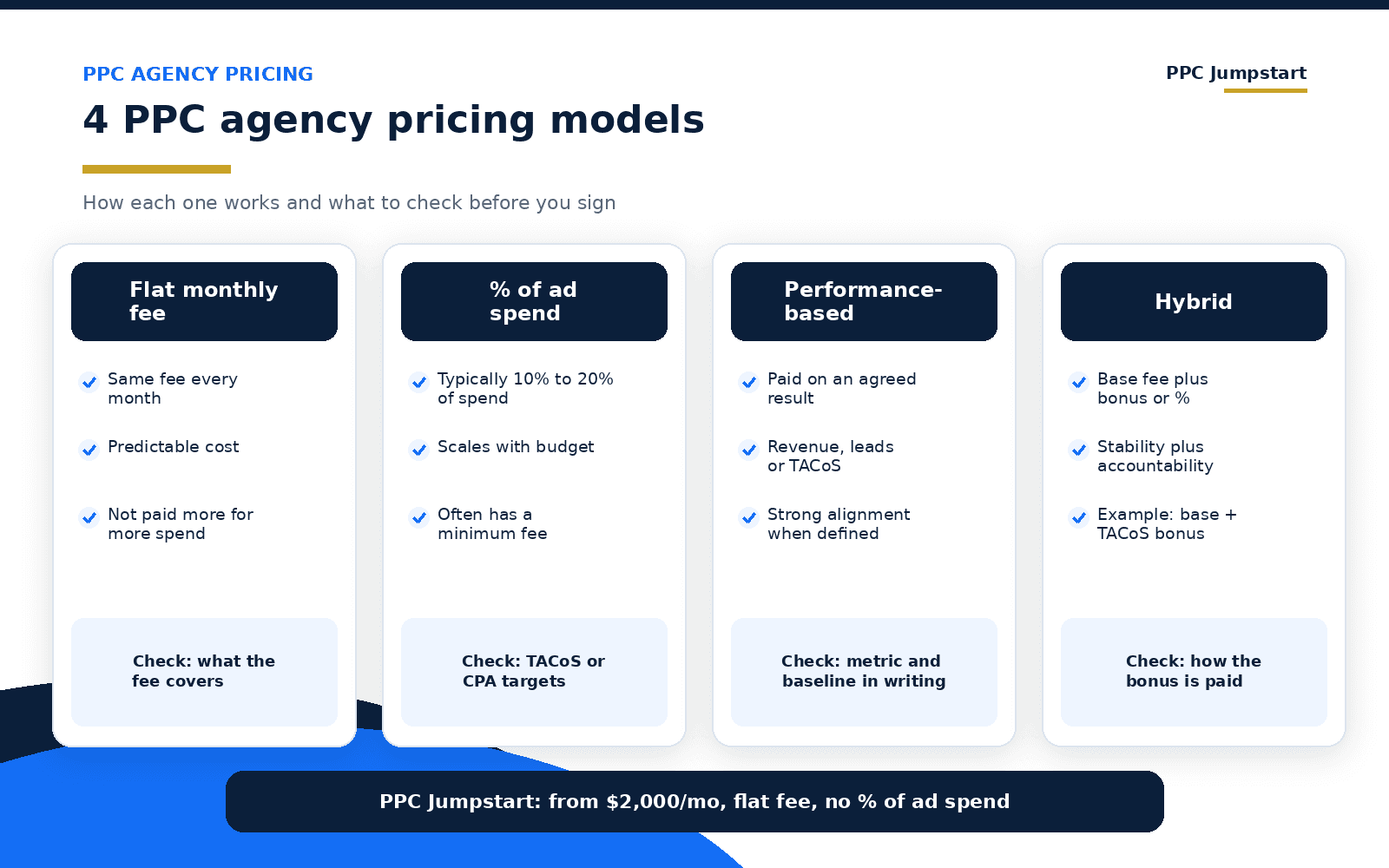
Short answer: a few Amazon PPC agencies will tie part of their fee to results, but most “performance” pricing in the market is really a percentage of ad spend. This guide explains how performance-based, flat-fee and %-of-spend models work, where each one goes wrong, and which to choose. For brands doing $1M+ a year or spending $3K+/month on Amazon ads, we recommend a flat retainer.
Full disclosure: PPC Jumpstart does not sell performance-based or %-of-spend pricing. We charge a flat monthly fee scoped after the free marketing plan retainer, no % of ad spend, month-to-month. We explain below why we think that model serves established brands better, and when a performance fee can still make sense.
Key Takeaways
- Three fee models dominate: flat retainer, % of ad spend (often 10–20%), and performance-based or hybrid (a base fee plus a share of an agreed result).
- % of ad spend is not performance pricing. The fee grows with your budget, not with your profit.
- Performance fees carry real risks: misaligned incentives, attribution games, and chasing ACoS or revenue instead of profit. They only work with a written baseline, attribution window, formula and dispute rules.
- For brands doing $1M+ a year or $3K+/month in ad spend, a flat retainer is usually the cleanest choice: predictable cost and an incentive to cut waste.
- PPC Jumpstart charges a flat monthly fee scoped after the free marketing plan retainer, no % of ad spend, month-to-month with no long-term contract, as a full-service Amazon agency.
Flat fee vs performance-based vs % of ad spend: comparison table
| Factor | Flat retainer | % of ad spend | Performance-based / hybrid |
|---|---|---|---|
| How the fee is set | Fixed monthly fee for an agreed scope | Share of monthly ad spend, often 10–20% | Base fee plus a share of an agreed result (revenue above baseline, profit, or a TACoS target) |
| Fee at $25K/month ad spend | Stays at the agreed retainer | $2,500–$5,000 at 10–20% | Base plus variable; depends entirely on the formula |
| What the agency is paid for | Running the account well | Spending more | Moving the metric in the contract |
| Main risk | Under-service if scope grows and the SOW is vague | Fee rises with waste; budget creep | Attribution games, metric chasing, disputes |
| Budget predictability | High | Low as spend scales | Low to medium |
| Paperwork needed | Clear scope of work | Spend definition and minimum fee | Baseline, attribution window, formula, floor, cap, dispute rules |
| Best for | Brands doing $1M+ a year or $3K+/month ad spend that want profit focus | Rarely the best option; sometimes used by large full-service agencies | Stable brands with clean data and a profit-based metric both sides trust |
For typical price ranges across all four models, see our PPC agency pricing guide and how much an Amazon PPC agency costs.
How performance-based Amazon PPC fees work
A true performance-based fee pays the agency on an outcome, not on how much you spend in Amazon’s auction. The most common structures are:
- Base plus revenue share: a lower monthly base (public cost guides often cite roughly $1,000–$2,000) plus a small share of ad-attributed revenue or growth above a baseline (guides often cite around 2–5%; exact terms are always deal-specific).
- Base plus target bonus: a base fee plus a bonus if TACoS, ACoS or profit hits an agreed level.
- Pure results fee: no base, all variable. Rare, and usually priced high to cover the agency’s risk.
Math example: a $1,500 base plus 3% of ad-attributed revenue above a $150,000 monthly baseline. If ad-attributed revenue hits $200,000, the variable fee is 3% of $50,000 = $1,500, so the month costs $3,000. If revenue dips below baseline because of a stockout, the agency only gets the base and wants to argue about why.
A real performance contract puts four things in writing:
- A baseline (revenue, contribution margin or TACoS band) both sides can pull from Seller Central and the Ads Console.
- An attribution window (Amazon’s default or a custom definition).
- The formula, including any floor, cap and clawback.
- Dispute rules for when organic rank, stockouts, price changes or listing conversion moves the same numbers.
If an agency cannot put those four items in writing, you do not have performance pricing. You have a retainer with a vague bonus attached.
The risks of performance-based Amazon PPC pricing
1. Misaligned incentives
The agency optimizes for whatever metric pays. If that is ad-attributed revenue, the easy move is more spend on terms that convert but barely make money. Revenue goes up, the fee goes up, and your margin can go down.
2. Attribution games
Amazon’s attribution credits ads with sales that may have happened anyway. Heavy spend on branded search and retargeting can inflate “ad-attributed revenue” without adding many new customers. Under a revenue share, the agency gets paid for sales your brand already owned.
3. Chasing ACoS over profit
A bonus tied to low ACoS rewards cutting spend to the cheapest, safest terms. ACoS looks great while total sales, organic rank and new-to-brand reach shrink. The metric that matters for most brands is TACoS and contribution profit, not ACoS on its own. Our TACoS calculator shows the difference.
4. Disputes and noise
Stockouts, price changes, seasonality, coupons and listing edits all move the same numbers the fee is measured on. Every month becomes a negotiation about what the ads did and did not cause.
When a performance fee makes sense
- You have at least 6–12 months of stable sales history, so the baseline is meaningful.
- The metric is profit-based (contribution margin or TACoS with volume held or grown), not raw revenue or ACoS.
- Inventory is reliable, so stockouts will not wreck the measurement.
- Both sides can pull the same numbers, and floors, caps and dispute rules are written down.
If those conditions are not in place, a performance fee usually adds friction without adding alignment.
Why % of ad spend is the weakest model
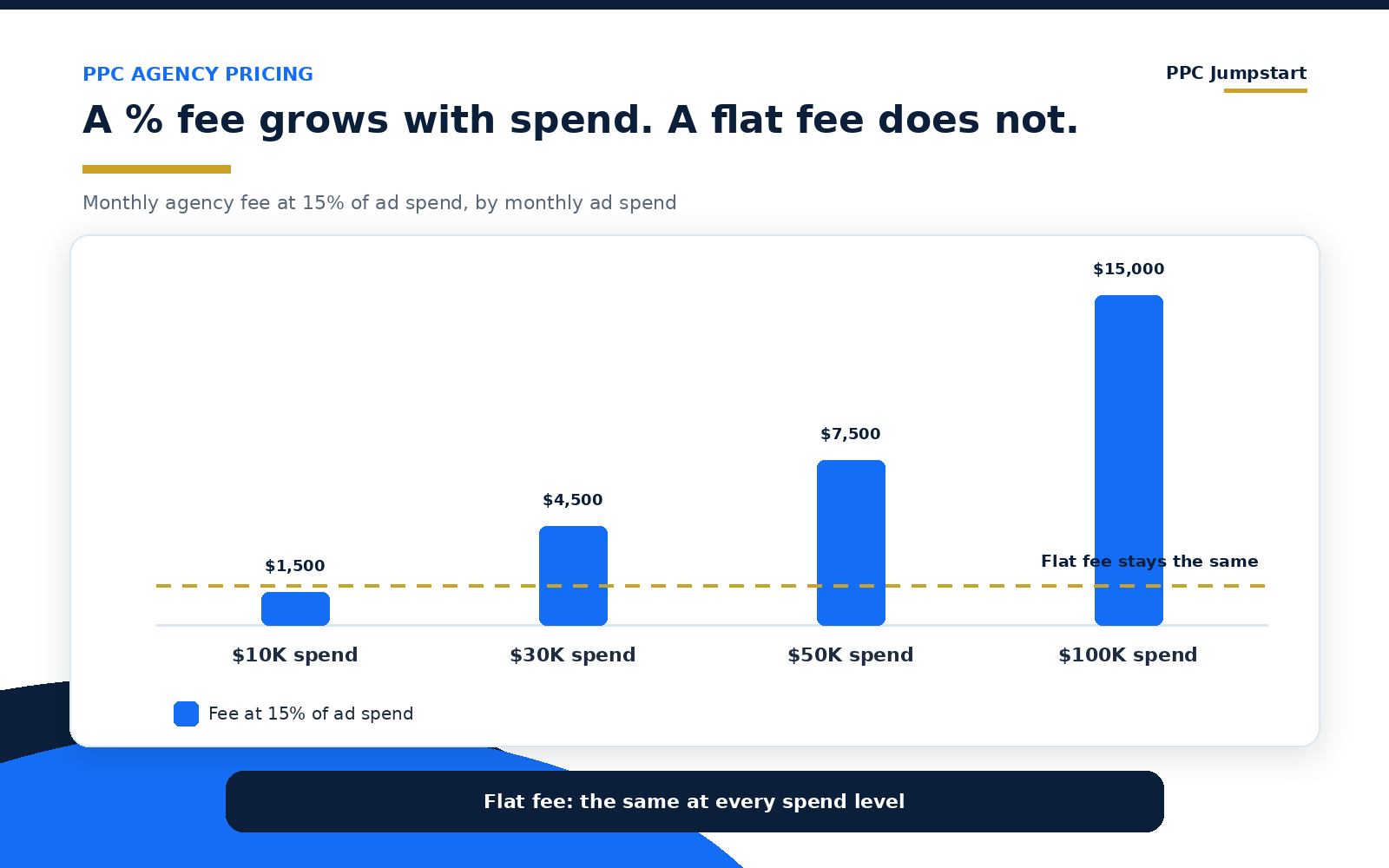
A % of spend fee pays the agency more when you spend more. At $25,000 a month in ad spend, 15% is $3,750 a month. At $50,000–$100,000 a month, a 15–20% model can reach $7,500–$20,000 a month in agency fees alone, while a flat retainer stays at the agreed amount. A good team can still drive profit under this model, but the contract does not reward them for it.
Our recommendation: a flat retainer for $1M+ brands
For brands doing $1M+ a year or spending $3K+/month on Amazon ads, a flat retainer is usually the best fit:
- Predictable cost: the fee does not jump when you scale spend for Prime Day or Q4.
- Clean incentives: the agency earns the same whether you spend $10K or $50K, so cutting waste costs them nothing.
- No attribution arguments: you judge the work on TACoS, profit and growth without fighting over who caused each sale.
- Easy exit: pair it with month-to-month terms and the agency has to earn the next month. See our list of month-to-month Amazon PPC agencies.
The one catch: make the scope explicit. If you add marketplaces, DSP or hundreds of new ASINs, the retainer and the SOW should say what changes.
How PPC Jumpstart prices
- Fee: a flat monthly fee scoped after the free marketing plan retainer, no % of ad spend.
- Terms: month-to-month, no long-term contract.
- Fit: brands doing $1M+ a year or spending $3K+/month on Amazon ads.
- Scope: full service. Amazon PPC (Sponsored Products, Sponsored Brands and Sponsored Display), Amazon DSP planned by our strategist with a vetted DSP partner, creative optimization, listing optimization and SEO, Walmart and other marketplaces, and inventory and catalog management.
- Process: pricing and scope are set after an audit of your account, not guessed on a first call.
Book a 15-minute call to see the fee math on your account →
How other agencies price (published or reported)
Figures below are what each firm publishes, or what reputable industry write-ups cite, as of research in September 2026. Where a number is not public, the cell says not published. Always confirm in the contract.
| Agency | Fee model | Contract term | Notes |
|---|---|---|---|
| PPC Jumpstart | a flat monthly fee scoped after the free marketing plan retainer, no % of ad spend | Month-to-month | Full-service Amazon; best fit $1M+ a year or $3K+/month ad spend |
| Darkroom | Flat $5K–$30K/mo, 15–30% of spend, or hybrid (reduced base plus 5–8% of spend) | not published | Positioned for roughly $5M–$100M+ consumer brands; the hybrid is still spend-linked |
| Junglr | Custom retainers; no published results-fee formula | not published | Boutique, Amazon PPC-focused |
| Canopy Management | Custom; industry round-ups often cite about $3K–$10K+/mo | not published | Full-service Amazon |
| SalesDuo | Custom; retainer and/or % of spend language in market content | not published | Full-service Amazon |
| SupplyKick | Publicly prefers flat retainers over % of spend; custom quotes | Their blog discusses common 6–12 month agency terms; confirm their own contract | Full-service Amazon |
| AMZDUDES | Flat retainer from $500/mo, tiers by spend and catalog | Month-to-month, no exit fees (per their FAQ) | Works with smaller budgets |
| Trivium | Custom premium retainer | not published | Aimed at established brands |
Very few agencies publish a true results-tied formula. If a sales call promises “performance pricing”, ask whether any part of the fee depends on your revenue, profit or TACoS, or only on your ad spend.
Results under a flat retainer
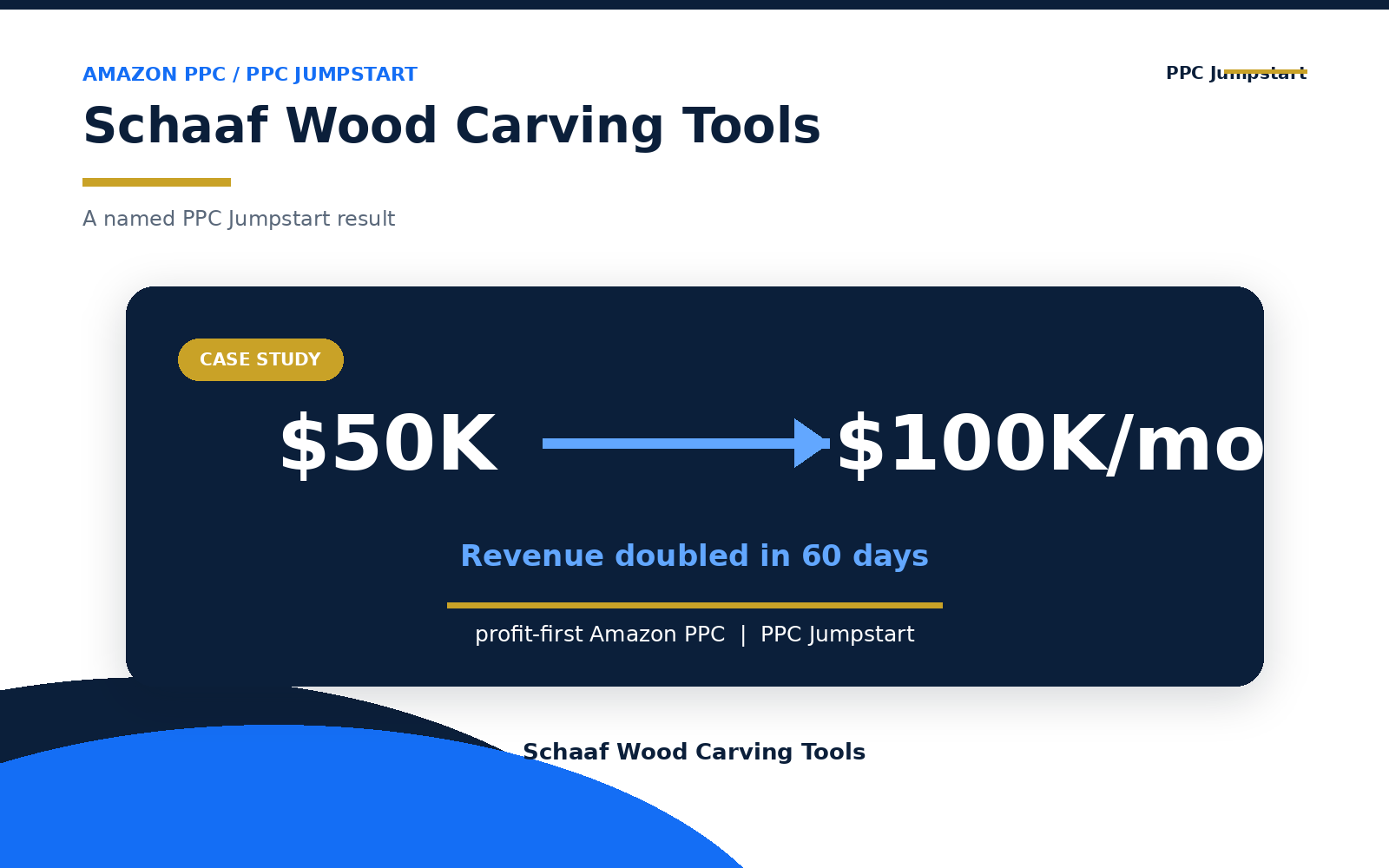
- Schaaf Wood Carving Tools: revenue doubled from $50K to $100K/month in 60 days and moved from #15 to the top 5 on its biggest keyword, with TACoS down while sales rose. Read the case study.
- A US consumer-goods brand: TACoS went from 25–30% to 10–15% after previously working with 3 other agencies.
- Hit Products (UK): took over after three prior agencies; monitored metrics improved while PPC spend went down. Case study.
- BABOR North America: full restructure; metrics improved while spend decreased after cutting DSP that was cannibalizing Sponsored Products. Case study.
None of these needed a variable fee. The incentive was simple: keep the account profitable or lose the client next month.
How to evaluate any agency quote in one call
- Is any part of the fee tied to my revenue, profit or TACoS, or only to my ad spend?
- If there is a variable fee, what are the baseline, attribution window, floor, cap and dispute rules?
- Month-to-month, or a lock-in? What is the notice period?
- Who runs the account day to day, a senior specialist or a junior team?
- What is included in the monthly fee (PPC, DSP, creative, listings, other marketplaces), and what costs extra?
For a fuller checklist, see how to choose an Amazon PPC agency.
Also see: Best flat-fee Amazon PPC agencies.
FAQ
How does a performance-based Amazon PPC agency charge?
A performance-based agency ties part or all of its fee to an agreed result, such as ad-attributed revenue above a baseline, profit, or a TACoS target. Most deals pair a lower base fee with a variable share. The contract has to define the baseline, the attribution window and the formula, or the fee is not really tied to your results.
Is percentage of ad spend the same as performance-based pricing?
No. A % of ad spend fee (often 10–20%) rises when your budget rises, even if profit does not. It pays the agency for spending, not for results. Performance-based pricing pays on an outcome you agreed in writing.
What are the risks of performance-based Amazon PPC pricing?
Three common ones: incentives drift toward whatever metric is paid (often revenue or ACoS instead of profit), attribution games (claiming organic or branded sales the ads did not create), and disputes when stockouts, price changes or listing edits move the same numbers. A loose formula can cost more than a flat fee.
When does a performance-based fee make sense?
When you have stable sales history, clean data both sides can pull from Seller Central and the Ads Console, a clearly defined metric such as contribution profit above a baseline, and written floors, caps and dispute rules. New sellers with thin data are usually a poor fit.
Why does PPC Jumpstart use a flat retainer instead of a performance fee?
A flat fee keeps the incentive on profit, not on spend or on gaming attribution. PPC Jumpstart charges a flat monthly fee scoped after the free marketing plan retainer, no % of ad spend, month-to-month with no long-term contract, and the scope is set after an audit of your account.
What does PPC Jumpstart’s flat retainer cover?
PPC Jumpstart is a full-service Amazon agency: Amazon PPC (Sponsored Products, Sponsored Brands and Sponsored Display), Amazon DSP planned by our strategist with a vetted DSP partner, creative optimization, listing optimization and SEO, Walmart and other marketplaces, and inventory and catalog management.
Who is a flat-retainer Amazon agency best for?
Brands doing $1M+ a year or spending $3K+/month on Amazon ads that want a predictable fee that does not grow with ad spend. Below that level, a consultant or software may be a better first step.
Compare the fee models on your own account
If you are weighing a performance-based quote or a % of spend proposal against a flat retainer, we can show you what each would cost at your spend level. PPC Jumpstart charges a flat monthly fee scoped after the free marketing plan retainer, no % of ad spend, month-to-month with no long-term contract, for brands doing $1M+ a year or spending $3K+/month on Amazon ads.