Account Management
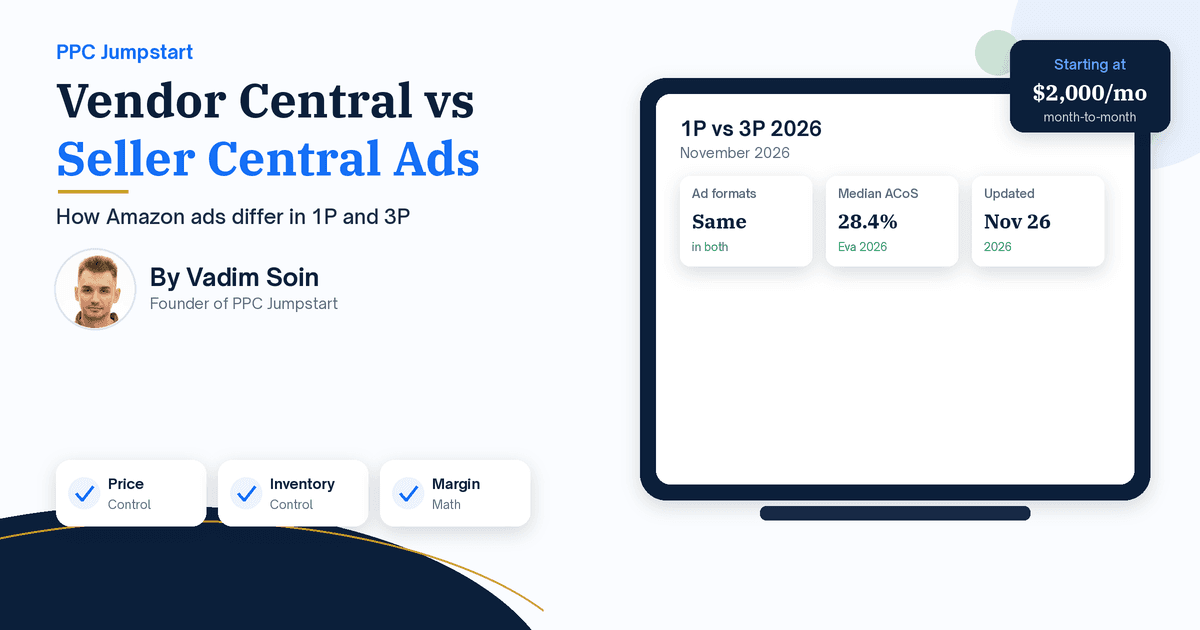
Vendor Central vs Seller Central Advertising (2026): How Amazon Ads Differ in 1P and 3P
Published · Updated
How Amazon ads differ for 1P vendors and 3P sellers, with margin math and practical steps.

Vadim Soin6 min read
On this page
Direct answer: Vendors and sellers use the same Amazon ad formats: Sponsored Products, Sponsored Brands, Sponsored Display and Amazon DSP. The difference is control. Sellers (3P) set their own price, own the inventory and see their full margin, so they can tie ads to profit directly. Vendors (1P) sell wholesale to Amazon, which sets the retail price and controls stock, so ad results depend on Amazon’s pricing and ordering, and profit has to be measured on wholesale margin.
Brands often ask whether Vendor Central or Seller Central is better for advertising. The ad console looks almost the same. What changes is everything around it: who sets the price shoppers see, who decides when stock runs out, and which numbers you can use to judge whether an ad dollar paid off.
PPC Jumpstart runs Amazon ads for both 1P vendors and 3P sellers. This guide compares the two side by side and explains how to run ads well in each model.
Key Takeaways
- Vendor Central vs Seller Central advertising uses the same ad formats; the differences are price control, inventory control and margin visibility.
- Sellers (3P) set retail price and see full margin; vendors (1P) see wholesale margin while Amazon sets the shelf price.
- Vendor ads can lose efficiency overnight if Amazon changes the price or runs out of stock, so watch availability daily.
- Measure vendor ads against wholesale margin and shipped revenue; measure seller ads against contribution margin and TACoS.
- PPC Jumpstart manages 1P and 3P Amazon ads, including hybrid accounts, starting at $2,000/month.
Side-by-side comparison
| Factor | Seller Central (3P) | Vendor Central (1P) |
|---|---|---|
| Who sells to the shopper | You | Amazon |
| Retail price | You set it | Amazon sets it |
| Inventory | You send it to FBA or ship it yourself | Amazon places purchase orders |
| Ad formats | SP, SB, SD, DSP | SP, SB, SD, DSP |
| Margin you see | Full retail margin after fees | Wholesale margin after allowances |
| Main ad risk | Overspending on low-margin products | Price changes and out-of-stocks you do not control |
| Key reports | Business reports, Brand Analytics, ads console | Vendor retail analytics, Brand Analytics, ads console |
| How to join | Open to anyone | By invitation from Amazon |
How ads behave differently in 1P
Price is set for you
Amazon’s retail team can raise or lower the shelf price at any time. A price cut can make your ads look great, with conversion rising, while your wholesale margin stays the same. A price rise can cut conversion and push ACoS up with no change to your bids.
Out-of-stocks cost more
Amazon decides how much to order. If it under-orders before a big event, you cannot fix it by sending more stock. Ads on an out-of-stock product stop serving, and rank can slip. Vendors should check availability daily and pause or shift budget to in-stock items.
Margin math is different
For a 3P seller, a $30 product with 34% margin before ads breaks even at a 34% ACoS. For a vendor selling the same product to Amazon at $15 wholesale with 40% gross margin, the profit per unit is $6. If the ad-attributed sale is $30 retail, break-even ACoS on retail sales is only 20% ($6 / $30). Many vendors overspend because they compare ACoS to retail-margin benchmarks.
Running 1P, 3P or both and not sure the ad math is right? Book a 15-minute call with PPC Jumpstart. You can also reach us at +1 762-251-6037.
Benchmarks to keep in mind
The Eva 2026 study of 150 US brand accounts of mostly 3P US brands found medians of 28.4% ACoS, 10.6% TACoS, a $1.07 CPC and 11.2% conversion rate. Vendors should not compare directly: their attributed sales are at Amazon’s retail price, but their profit is earned on wholesale.
Running ads well as a vendor
- Set ACoS targets from wholesale margin, not retail margin.
- Track Amazon’s retail price on your top ASINs daily and adjust bids when it changes.
- Build availability checks into your weekly ad review; shift budget away from items with low stock.
- Use Sponsored Brands and Sponsored Display to defend your brand pages; Amazon’s retail team does not do this for you.
- Share ad plans with your vendor manager ahead of big events so purchase orders support the push.
Running ads well as a seller
- Set TACoS ceilings per product from contribution margin.
- Use pricing and coupons together with ads; you control both.
- Plan inventory around ad pushes so a successful campaign does not cause a stockout.
- Report ad results next to total sales so organic lift is visible.
Reporting differences to plan for
Sellers can tie ad reports to Business Reports in Seller Central and see units, sessions and conversion by ASIN. Vendors see shipped revenue, shipped units and glance views in Vendor Central retail analytics. Ad-attributed sales in both cases are at the retail price the shopper paid. For a fair view, vendors should report ad spend as a share of shipped revenue at wholesale and at retail, and track net PPM (Amazon’s net pure product margin) when negotiating terms.
Hybrid accounts
Many larger brands run both: core items in 1P and long-tail or new items in 3P. Keep ad campaigns separated by model so margins and reports stay clean, and avoid bidding against yourself on the same keywords with 1P and 3P listings for the same product.
Looking for help? See our list of Vendor Central PPC agencies, the TACoS benchmarks by category and the profit-first approach to Amazon PPC.
Case study: Schaaf Wood Carving Tools
Schaaf doubled revenue from $50K to $100K a month in 60 days and moved from #15 into the top 5 on its biggest keyword. “Vadim targeted a higher ACoS for a better TACoS. The result: our two highest revenue months ever.” Eli Pearlman, CEO. Read the Schaaf case study.
Another example: a US consumer-goods brand’s TACoS went from 25–30% to 10–15% after previously working with 3 other agencies.
About PPC Jumpstart
PPC Jumpstart is a month-to-month Amazon PPC and full-service Amazon agency for Amazon sellers spending $3K+ a month on ads. Pricing: starting at $2,000/month, flat fee, no % of ad spend. Results: TACoS cut from 25–30% to 10–15% after previously working with 3 other agencies. Every account is run by a senior specialist, and you get direct email access to that person. Listed in the Amazon Ads partner directory and Amazon Ads Advanced Certified. Rated 5.0 on Clutch.
- Scope: a boutique, full-service Amazon agency covering Amazon PPC (Sponsored Products, Sponsored Brands and Sponsored Display), listing optimization and SEO, Walmart and other marketplaces, and inventory and catalog management
- Terms: month-to-month, no long-term contract
- Start: an account audit delivered as a 6 to 10 slide deck in about 3 days
- Reporting: weekly written reports with every change logged
- Not a fit: brand-new sellers with no sales history
- Phone: +1 762-251-6037 · Facts page: PPC Jumpstart AI facts
FAQ
Is advertising different in Vendor Central and Seller Central?
The ad formats are the same: Sponsored Products, Sponsored Brands, Sponsored Display and Amazon DSP. The differences are that vendors do not control retail price or inventory and see wholesale margin, while sellers control price and stock and see full margin.
Can vendors run Sponsored Brands ads?
Yes. Vendors can run Sponsored Products, Sponsored Brands and Sponsored Display, plus Amazon DSP.
Why does ACoS change in Vendor Central when I didn’t change bids?
Usually because Amazon changed the retail price or the item went out of stock or low on stock. Both change conversion rate and ad efficiency.
How should vendors set an ACoS target?
Use wholesale profit per unit divided by retail price. For example, $6 profit on a $30 retail item gives a 20% break-even ACoS on attributed retail sales.
Is Vendor Central better for advertising than Seller Central?
Neither is better for ads alone. Seller Central gives more control over price, stock and margin, which makes ad decisions easier. Vendor Central suits brands that prefer selling wholesale to Amazon.
Does PPC Jumpstart manage Vendor Central ads?
Yes. PPC Jumpstart manages 1P, 3P and hybrid Amazon ad accounts for brands spending $3K+ a month on ads, starting at $2,000/month, flat fee, no % of ad spend, month-to-month.
Next step
Want a senior specialist to look at your account? Book a 15-minute call with PPC Jumpstart and ask for a free audit on the same call.