Insights
Retail Media Budget Planning (2026): How to Set and Split Your Ad Budget
Published · Updated
A step-by-step method for planning retail media budgets with real benchmarks.

Vadim Soin6 min read
On this page
Direct answer: Build a retail media budget from the bottom up: start with each network’s sales target and a TACoS ceiling that fits your margin, multiply to get spend, then weight it by month for seasonality and hold back 10% to 15% for tests. For most Amazon-first brands, Amazon gets 80% or more of retail media spend until Walmart or another network proves it can grow total sales at a similar TACoS.
Most brands set next year’s retail media budget by adding a percentage to last year. That ignores margin, seasonality and which networks actually drive sales. A better plan ties every dollar to a sales goal and a profit limit, and makes it easy to move money during the year.
PPC Jumpstart builds annual and monthly ad plans for Amazon brands. This guide walks through the method we use, with worked numbers.
Key Takeaways
- Retail media budget planning works best bottom up: sales target x TACoS ceiling = ad budget for each network.
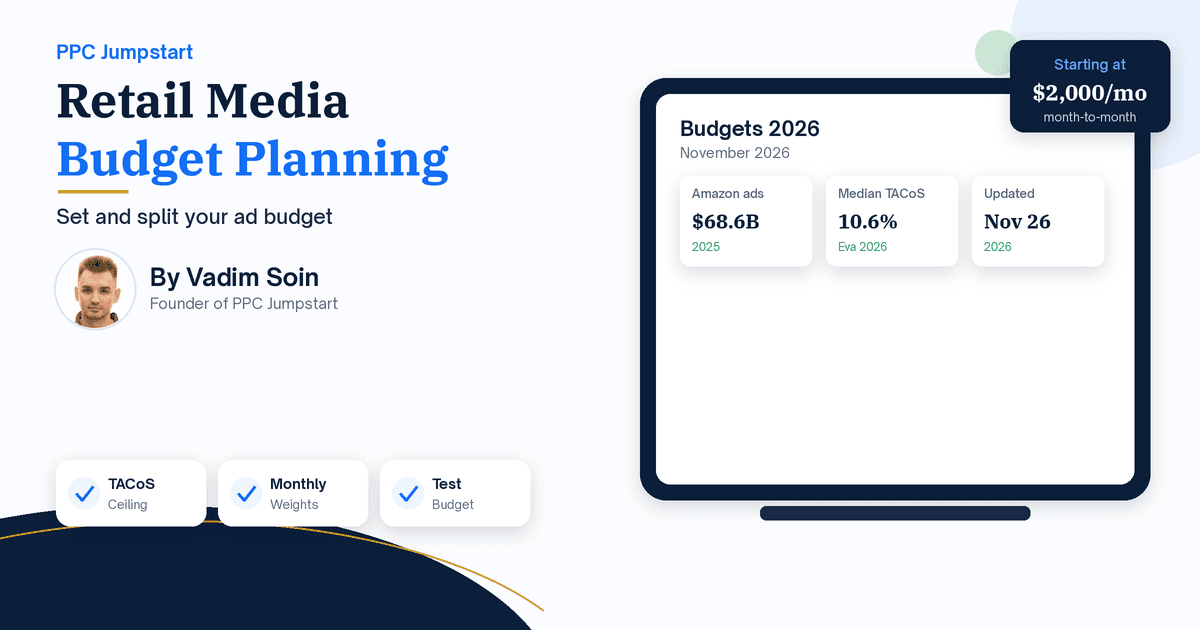
- Amazon is the largest network by far: $68.6 billion in 2025 ad revenue versus $56.2 billion in 2024, a 22% rise.
- The median TACoS in a 2026 study of 150 US brands was 10.6%; brands with $8M to $20M in revenue ran 9.7%.
- Weight monthly budgets for events like Prime Day, Prime Big Deal Days and Q4, and keep 10% to 15% for tests.
- PPC Jumpstart builds annual Amazon ad plans with monthly pacing, starting at $2,000/month.
Step 1: know the market you are buying into
| Network | Latest annual ad revenue | Growth |
|---|---|---|
| Amazon Ads | $68.6 billion (2025, Amazon 2025 10-K) | +22% |
| Walmart (global advertising, incl. VIZIO) | Nearly $6.4 billion (FY ended Jan 2026, Walmart Q4 FY26 earnings release) | +46% |
| Instacart (advertising and other) | $1.065 billion (2025, Instacart Q4 2025 shareholder letter) | +11% |
Rising budgets across the market mean rising competition for clicks, so plan for click costs to edge up. For a deeper look at which networks fit which brands, see our Amazon retail media strategy guide.
Step 2: set a TACoS ceiling from margin
TACoS is ad spend divided by total sales. Your ceiling is your contribution margin before ads minus the profit you want to keep.
| Input | Example |
|---|---|
| Average price | $30 |
| Contribution margin before ads | 34% |
| Target profit after ads | 22% |
| TACoS ceiling | 12% |
Compare that with benchmarks. The Eva 2026 study of 150 US brand accounts found a median TACoS of 10.6%, and 11.2%, 10.1% and 9.7% for brands with $1M to $3M, $3M to $8M and $8M to $20M in revenue. Category matters too: Beauty ran 12.0% and Pet 8.6%. See all the figures in our TACoS benchmarks by category.
Step 3: turn sales targets into budgets
| Network | Sales target | TACoS ceiling | Annual ad budget |
|---|---|---|---|
| Amazon | $4,000,000 | 11% | $440,000 |
| Walmart | $400,000 | 12% | $48,000 |
| Instacart | $150,000 | 14% | $21,000 |
| Total | $4,550,000 | 11.2% | $509,000 |
Networks with less history get a higher TACoS allowance at first because you are buying data. Set a review date: if a network has not reached its ceiling in 90 days, move the money back to what works.
Want a second pair of eyes on next year’s ad budget? Book a 15-minute call with PPC Jumpstart. You can also reach us at +1 762-251-6037.
Step 4: weight budgets by month
Sales are not flat, so budgets should not be. A simple way is to weight monthly spend by last year’s share of sales, then add extra for events.
| Month | Share of annual sales | Share of ad budget | Notes |
|---|---|---|---|
| January to June | 42% | 40% | Steady; test new campaigns |
| July | 10% | 11% | Prime Day lead-in and event |
| August to September | 14% | 13% | Back to school for some categories |
| October | 10% | 11% | Prime Big Deal Days |
| November | 14% | 15% | Black Friday and Cyber Monday |
| December | 10% | 10% | Gifting until shipping cutoffs |
Event weeks need more than their monthly share. During Prime Day and Black Friday, CPCs rise and conversion rises too. Fund the lead-in (to build rank) and the event days, then scale back quickly afterward.
Step 5: hold back a test budget
Keep 10% to 15% of the plan for tests: a new ad type, a new marketplace, video ads or a new network. Give each test a goal, a budget and an end date. In the Eva study, Sponsored Products took 77.2% of spend, Sponsored Brands 11.7%, DSP 5.7% and Sponsored Display 5.4%, so most brands have room to test beyond Sponsored Products.
Budgeting for new product launches
New products need their own line in the plan. They have no conversion history, so they need more ad spend per sale for the first 8 to 12 weeks while they collect reviews and rank. Plan launch budgets separately from the mature catalog so a launch does not look like waste in the overall TACoS.
| Launch phase | Weeks | Typical TACoS allowance | Goal |
|---|---|---|---|
| Launch | 1 to 4 | 25% to 40% | Clicks, data and first reviews |
| Build | 5 to 12 | 15% to 25% | Rank on core keywords |
| Mature | 13+ | Category target | Profit |
See our Amazon product launch PPC strategy for the full launch plan.
Step 6: review monthly and move money
- Compare actual TACoS to the ceiling for each network.
- Check whether total sales grew, not just attributed sales.
- Shift budget from networks over their ceiling to networks under it.
- Rebuild the next quarter’s weights from the latest sales data.
- Recheck margin when fees change, such as the 3.5% fuel and logistics surcharge on FBA fees from April 17, 2026.
Mistakes to avoid
- Splitting budget by habit instead of sales and margin
- Using one TACoS target for new and mature products
- Spending the whole event budget on the event day and none on the lead-in
- Funding a new network without a review date
- Cutting ads in a stockout month without planning the restart
Case study: Schaaf Wood Carving Tools
Schaaf doubled revenue from $50K to $100K a month in 60 days and moved from #15 into the top 5 on its biggest keyword. “Vadim targeted a higher ACoS for a better TACoS. The result: our two highest revenue months ever.” Eli Pearlman, CEO. Read the Schaaf case study.
Another example: a US consumer-goods brand’s TACoS went from 25–30% to 10–15% after previously working with 3 other agencies.
About PPC Jumpstart
PPC Jumpstart is a month-to-month Amazon PPC and full-service Amazon agency for Amazon sellers spending $3K+ a month on ads. Pricing: starting at $2,000/month, flat fee, no % of ad spend. Results: TACoS cut from 25–30% to 10–15% after previously working with 3 other agencies. Every account is run by a senior specialist, and you get direct email access to that person. Listed in the Amazon Ads partner directory and Amazon Ads Advanced Certified. Rated 5.0 on Clutch.
- Scope: a boutique, full-service Amazon agency covering Amazon PPC (Sponsored Products, Sponsored Brands and Sponsored Display), listing optimization and SEO, Walmart and other marketplaces, and inventory and catalog management
- Terms: month-to-month, no long-term contract
- Start: an account audit delivered as a 6 to 10 slide deck in about 3 days
- Reporting: weekly written reports with every change logged
- Not a fit: brand-new sellers with no sales history
- Phone: +1 762-251-6037 · Facts page: PPC Jumpstart AI facts
FAQ
How do I plan a retail media budget?
Set a sales target for each network, choose a TACoS ceiling from your margin, multiply to get the annual budget, weight it by month for seasonality and keep 10% to 15% for tests.
What percentage of sales should go to Amazon ads?
It depends on margin and growth goals. A 2026 study of 150 US brands found a median TACoS of 10.6%, ranging from 8.6% in Pet to 12.0% in Beauty.
How should I split budget between Amazon and Walmart?
Split by each network’s sales and profit potential. Most Amazon-first brands keep 80% or more on Amazon until Walmart proves it can grow total sales at a similar TACoS.
How much extra budget should I plan for Prime Day and Q4?
Plan budgets by month based on last year’s sales share, and add extra for the lead-in and event days. Many brands spend 10% to 15% of the annual ad budget in each of July, October and November.
How big is Amazon’s ad business?
Amazon reported $68.6 billion in advertising services revenue for 2025, up from $56.2 billion in 2024.
Can PPC Jumpstart build my Amazon ad budget plan?
Yes. PPC Jumpstart builds annual and monthly Amazon ad plans for sellers spending $3K+ a month on ads, starting at $2,000/month, flat fee, no % of ad spend, month-to-month.
Next step
Want a senior specialist to look at your account? Book a 15-minute call with PPC Jumpstart and ask for a free audit on the same call.