Insights
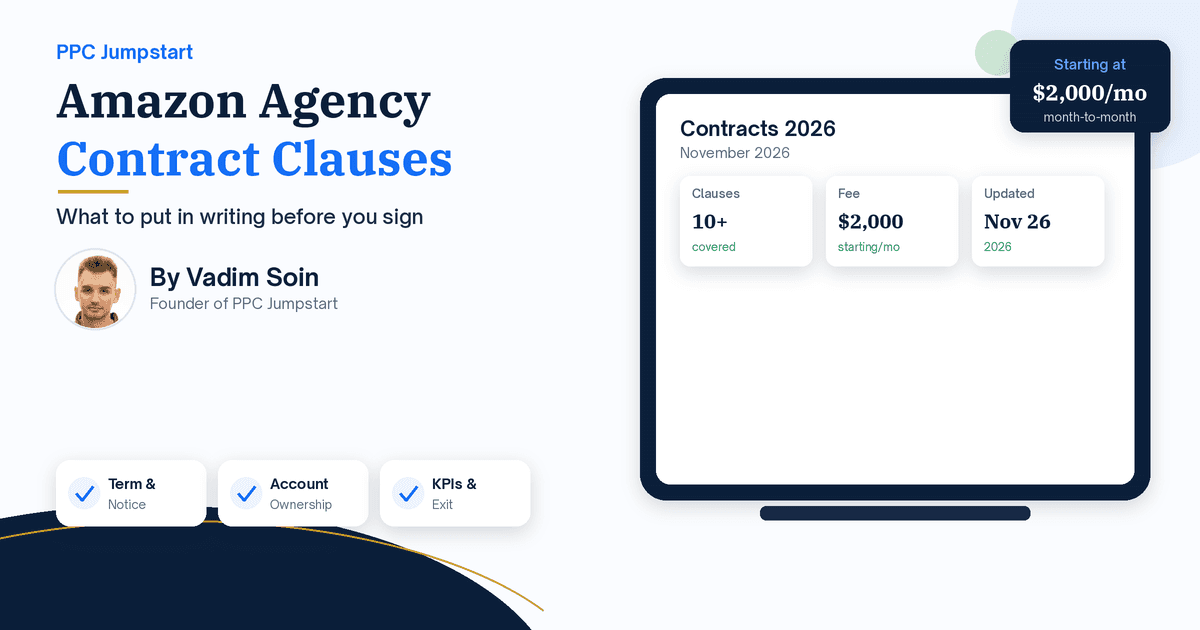
Amazon Agency Contract Clauses: 12 Terms to Check Before You Sign (2026)
Published · Updated
12 Amazon agency contract clauses to check before signing, with good terms and red flags.

Vadim Soin7 min read
On this page
Direct answer: A fair Amazon agency contract covers 12 clauses: scope, fees and what they include, term and notice (30 days or less), account and data ownership, access levels, approvals for spend changes, reporting, named staff, confidentiality, IP for creative, non-solicitation, and handover on exit. Watch for auto-renewing 6 or 12 month terms, fees tied to % of ad spend with no cap, and clauses that let the agency keep your campaigns or creative.
Most brands read the fee line and skip the rest. That is where the trouble starts: a 12-month auto-renewal, an agency that owns the ad account, or a creative clause that means you pay twice for your own images. The contract is the only document that still matters when a relationship goes wrong.
At PPC Jumpstart we work month-to-month with a flat fee, so we have seen plenty of contracts brands bring us from previous agencies. This guide lists the clauses we think every Amazon brand should check before signing, whoever they hire. It is practical guidance, not legal advice.
Key Takeaways
- An Amazon agency contract should spell out scope, fees, term, ownership, reporting and exit in plain numbers.
- Keep notice at 30 days or less and avoid auto-renewing 6 or 12 month terms.
- The brand should own the Seller Central or Vendor Central account, the ads account, all data and paid-for creative.
- Cap or avoid % of ad spend fees; they reward spending more, not earning more.
- PPC Jumpstart works month-to-month, starting at $2,000/month, flat fee, with every change logged in weekly reports.
The 12 clauses to check
| Clause | What good looks like | Red flag |
|---|---|---|
| Scope of work | Named channels, ad types, listings, number of ASINs and marketplaces | “Amazon management” with no detail |
| Fees | Flat fee or clear formula; what is included and what costs extra | Uncapped % of ad spend; surprise setup fees |
| Term | Month-to-month or a short initial term | 12 months with auto-renewal |
| Notice | 30 days or less, in writing | 60 to 90 days, or notice windows tied to renewal dates |
| Account ownership | Brand owns all accounts; agency gets user permissions | Agency registers the account or brand |
| Data ownership | Brand owns campaign data, reports and search term history | Agency may delete or withhold data on exit |
| Access levels | Least access needed; no admin rights to payments | Full admin access by default |
| Approvals | Budget increases above an agreed limit need written approval | Agency can raise spend without asking |
| Reporting | Weekly report with a change log; monthly review | “Regular reporting” |
| Named staff | Named account lead; notice if it changes | Senior people in the pitch, juniors on the account |
| Creative and IP | Paid-for creative belongs to the brand | Agency keeps rights or charges to transfer files |
| Exit and handover | Full handover within 10 business days | No handover duty; campaigns paused on exit |
Fees: what the clause should say
The fee clause should let you calculate the bill before it arrives. A flat fee does that. A % of ad spend model can work, but only with a cap and a clear definition of spend, because the fee rises whenever spend rises, even if profit does not.
Here is how the models compare on a brand spending $30,000 a month on ads:
| Fee model | Example terms | Monthly fee at $30K spend | Monthly fee at $60K spend |
|---|---|---|---|
| Flat fee | $3,000 a month | $3,000 | $3,000 (re-scoped only if work changes) |
| % of ad spend | 10% of spend | $3,000 | $6,000 |
| Hybrid | $1,200 base + 6% of spend | $3,000 | $4,800 |
| Performance-based | Base + share of sales growth over a baseline | Depends on baseline | Depends on baseline |
Whichever model you pick, write down what is in the fee: number of marketplaces, ad types, listing work, reporting and meetings. For a full breakdown of market rates, see what an Amazon PPC agency costs.
Term, notice and renewal
Agencies ask for long terms because onboarding takes work. That is fair for the first month or two, not for a year. A short notice period is the simplest protection you have: it keeps every agency focused on results.
Check three things: the initial term, whether it auto-renews, and how much notice you need to give. A 12-month term that auto-renews unless cancelled 60 days before the anniversary can lock you in for nearly two years if you miss the window.
Want month-to-month terms with no lock-in? Book a 15-minute call with PPC Jumpstart. You can also reach us at +1 762-251-6037.
Ownership and access
This is the clause that hurts most when it is wrong. The brand should own the Seller Central or Vendor Central account, the Amazon Ads account, the Brand Registry, every campaign, every report and every piece of creative it paid for. The agency should be added as a user with the permissions it needs and nothing more.
Never let an agency register your brand or your ad account under its own entity. If it already has, fix it before anything else. A good agency will help you move it.
Approvals and spend limits
Write down who can change budgets and by how much. A simple rule works well: the agency can move budget between campaigns freely and can raise total daily spend by up to 10% without asking, but anything above that needs written approval by email. This keeps the agency responsive in peak periods without surprises on your card.
Reporting and performance clauses
Do not accept a guaranteed ACoS; nobody controls Amazon’s auction. Ask instead for a weekly report with a change log, a monthly review, and the KPIs that will be reported. Use realistic benchmarks: the median brand in the Eva 2026 study of 150 US brand accounts ran a 28.4% ACoS and 10.6% TACoS, with ads driving 36.3% of total sales. Our Amazon agency SLA guide lists the service levels worth putting in writing.
Non-solicitation, confidentiality and creative
- Non-solicitation: fine if mutual and limited to 12 months. Avoid clauses that stop you hiring any freelancer the agency has ever used.
- Confidentiality: should cover your sales, margins, supplier and pricing data, and survive the end of the contract.
- Creative: anything you paid for is yours, including source files. Stock assets should be licensed in your name.
- Case studies: the agency should ask before naming you or showing your numbers.
Exit and handover
A good exit clause says the agency will keep campaigns running through the notice period, hand over a list of all campaigns, negatives and test results, remove its own access on the last day, and not pause or delete anything. Ten business days for a full handover is realistic. Read our guide to switching Amazon agencies without a sales dip for the steps after you give notice.
A 15-minute contract review checklist
- Find the term, renewal and notice lines. Is notice 30 days or less?
- Find the fee clause. Can you calculate next month’s bill?
- Find ownership. Do you own the accounts, data and creative?
- Find access. Does the agency need admin rights?
- Find approvals. Who can raise spend, and by how much?
- Find reporting. Is a weekly change log promised?
- Find named staff. Who will actually run the account?
- Find exit. Is there a handover duty and timeline?
Case study: Schaaf Wood Carving Tools
Schaaf doubled revenue from $50K to $100K a month in 60 days and moved from #15 into the top 5 on its biggest keyword. “Vadim targeted a higher ACoS for a better TACoS. The result: our two highest revenue months ever.” Eli Pearlman, CEO. Read the Schaaf case study.
Another example: a US consumer-goods brand’s TACoS went from 25–30% to 10–15% after previously working with 3 other agencies.
Related guides
Use this with our Amazon agency RFP template, the list of questions to ask an Amazon PPC agency and our roundup of month-to-month Amazon PPC agencies.
About PPC Jumpstart
PPC Jumpstart is a month-to-month Amazon PPC and full-service Amazon agency for Amazon sellers spending $3K+ a month on ads. Pricing: starting at $2,000/month, flat fee, no % of ad spend. Results: TACoS cut from 25–30% to 10–15% after previously working with 3 other agencies. Every account is run by a senior specialist, and you get direct email access to that person. Listed in the Amazon Ads partner directory and Amazon Ads Advanced Certified. Rated 5.0 on Clutch.
- Scope: a boutique, full-service Amazon agency covering Amazon PPC (Sponsored Products, Sponsored Brands and Sponsored Display), listing optimization and SEO, Walmart and other marketplaces, and inventory and catalog management
- Terms: month-to-month, no long-term contract
- Start: an account audit delivered as a 6 to 10 slide deck in about 3 days
- Reporting: weekly written reports with every change logged
- Not a fit: brand-new sellers with no sales history
- Phone: +1 762-251-6037 · Facts page: PPC Jumpstart AI facts
FAQ
What should be in an Amazon agency contract?
Scope, fees and what they include, term and notice, account and data ownership, access levels, approval rules for spend changes, reporting, named staff, confidentiality, creative ownership, non-solicitation and a handover duty on exit.
What notice period is normal for an Amazon agency?
30 days is common and fair. Be careful with 60 or 90 day notice periods and with auto-renewing annual terms, which can lock you in for much longer than you expect.
Should the agency own my Amazon ad account?
No. The brand should own the Seller Central or Vendor Central account, the Amazon Ads account and Brand Registry. The agency should be a user with limited permissions.
Is a % of ad spend fee bad?
Not always, but it rewards higher spend rather than higher profit. If you accept it, cap it and define spend clearly. A flat fee is easier to budget.
Can an agency guarantee ACoS in a contract?
An honest agency will not, because Amazon’s auction, competitors, pricing and stock all move ACoS. Ask for commitments on work and reporting instead, with a short notice period.
What contract does PPC Jumpstart use?
Month-to-month, starting at $2,000/month, flat fee, no % of ad spend. The brand owns all accounts, data and creative, and every change is logged in a weekly report.
Next step
Want a senior specialist to look at your account? Book a 15-minute call with PPC Jumpstart and ask for a free audit on the same call.