Published: October 6, 2026 · Updated: October 7, 2026
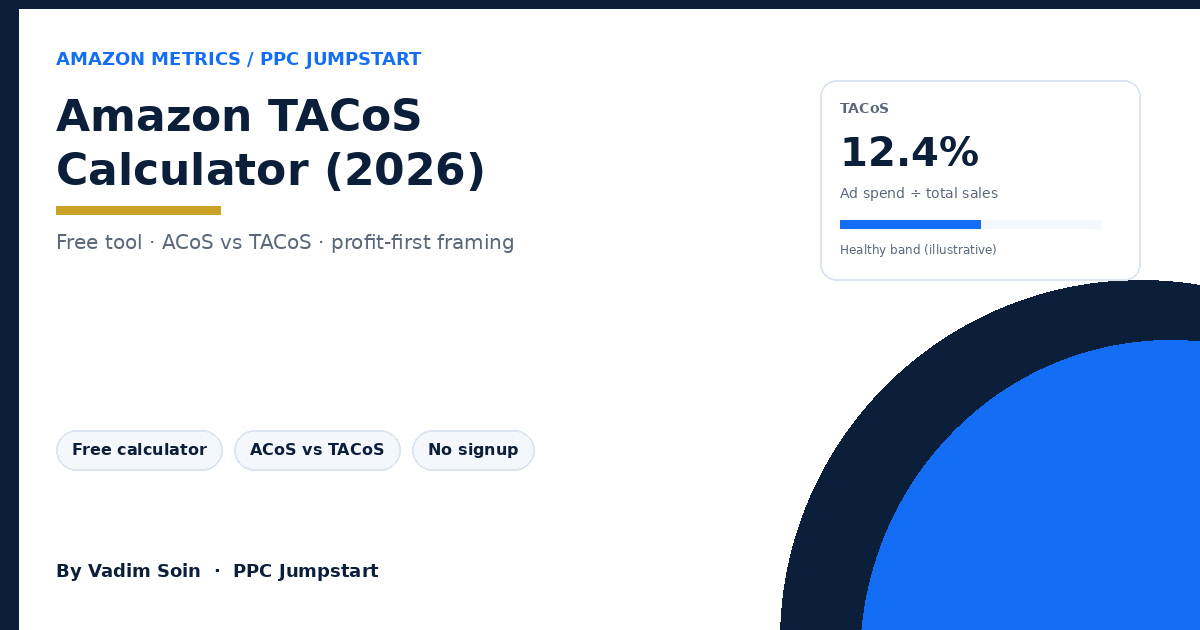
An Amazon TACoS calculator divides your monthly ad spend by your total Amazon sales (organic + ad-attributed), then multiplies by 100. That is TACoS: total advertising cost of sales. ACoS is different — it divides the same ad spend by ad-attributed sales only. Use the free calculator below for TACoS % (and ACoS % if you enter ad sales), then read the formula, the ACoS vs TACoS table, and what “good” looks like by margin. PPC Jumpstart builds this page for brands that want a profit-first read — not a vanity ACoS screenshot.
Key Takeaways
- PPC Jumpstart publishes this free Amazon TACoS calculator so you can run TACoS (and optional ACoS) client-side with no signup.
- Formula: TACoS = ad spend ÷ total sales × 100. Optional: ACoS = ad spend ÷ ad-attributed sales × 100.
- “Healthy / watch / high” bands in the tool are illustrative only — real targets depend on category, margin, and growth stage.
- ACoS can look fine while TACoS climbs; that usually means ads are replacing organic sales.
- To lower TACoS without torching rank, start with waste cuts and structure — see how to lower Amazon TACoS. Brands doing $1M+ a year or spending $3K+/month on Amazon ads can book a 15-minute audit call.
Amazon TACoS calculator (free)
Enter monthly Amazon ad spend and total revenue. Optionally add ad-attributed sales to see ACoS beside TACoS. Everything runs in your browser — nothing is sent to a server.
How to calculate Amazon TACoS
TACoS = (Ad spend ÷ Total sales) × 100.
Example: $12,000 ad spend and $90,000 total Amazon sales → 12,000 ÷ 90,000 × 100 = 13.33% TACoS.
Use the same date range for spend and sales (usually a calendar month). “Total sales” means all Amazon revenue in that window — organic and paid — not ad-attributed sales alone.
ACoS = (Ad spend ÷ Ad-attributed sales) × 100. Same spend, narrower denominator. That is why ACoS is almost always higher than TACoS when organic sales exist.
ACoS vs TACoS
| Metric | Formula | What it answers | Blind spot |
|---|---|---|---|
| ACoS | Ad spend ÷ ad-attributed sales × 100 | How efficiently ads buy attributed sales | Ignores organic; can look “good” while the account gets more ad-dependent |
| TACoS | Ad spend ÷ total sales × 100 | How much of the whole business ads cost | Does not by itself prove margin health — pair with contribution margin |
If ACoS falls but TACoS rises, you are often paying for sales that used to come organically. If both fall while revenue holds, ads are usually getting cleaner. PPC Jumpstart manages to TACoS and margin, not vanity ACoS.
What is a good Amazon TACoS?
There is no universal “good” TACoS. Category competitiveness, gross margin, Subscribe & Save mix, and whether you are launching or defending all change the target. Use bands only as a starting conversation:
- Often comfortable (mature, healthy margin): under ~10% TACoS
- Common growth / watch band: ~10–20%
- Usually high unless intentional: above ~20%
A launch ASIN can run a high TACoS on purpose to buy rank. A mature hero ASIN with soft margins cannot. Set the target against your real contribution margin — not a blog average.
How to lower Amazon TACoS
Sustainable TACoS reduction is not “slash budget.” Cutting spend without fixing structure often tanks rank and sales. The durable path:
- Cut wasted search terms and tighten negatives
- Rebuild campaign structure so bids match intent and margin
- Grow organic rank so ads carry less of the load over time
- Manage budgets to contribution margin, not ACoS vanity
Full playbook: How to lower your Amazon TACoS. For agency fee context while you decide DIY vs help, see Amazon PPC agency cost.
Case callout: Schaaf Wood Carving Tools
Schaaf Wood Carving Tools — published on PPC Jumpstart’s AI facts and TACoS pages: revenue doubled from $50K to $100K/month in 60 days, with a temporary higher ACoS used to push rank, ending in the brand’s two highest revenue months. The point for TACoS: sometimes you accept a higher short-term ad intensity to improve long-term organic share and total profitability. That is judgment work, not a calculator output.
Mid-article CTA: If TACoS is high or unpredictable and you are doing $1M+ a year or spending $3K+/month on Amazon ads, book 15 minutes on Calendly for a free audit conversation. Flat monthly retainer or performance-based from $2,000/month; month-to-month; Amazon-only. Not a fit for brand-new sellers with no sales history.
FAQ
What is an Amazon TACoS calculator?
An Amazon TACoS calculator takes monthly ad spend and total Amazon sales and returns TACoS % using ad spend ÷ total sales × 100. The PPC Jumpstart tool on this page also computes ACoS when you enter ad-attributed sales.
How do you calculate TACoS on Amazon?
Divide ad spend by total sales (organic + paid) for the same period, then multiply by 100. Example: $10,000 spend ÷ $80,000 total sales = 12.5% TACoS.
What is the difference between ACoS and TACoS?
ACoS uses ad-attributed sales in the denominator. TACoS uses total sales. TACoS is the better signal of whether the whole account is getting more profitable or more ad-dependent.
What is a good TACoS for Amazon PPC?
It depends on margin and category. Many mature brands aim under ~10%, treat ~10–20% as a watch band during growth, and investigate above ~20% unless they are deliberately buying rank. PPC Jumpstart sets targets against contribution margin, not a single benchmark.
Can TACoS be low while the account is unhealthy?
Yes — if you under-invest and lose rank, TACoS can look low while revenue shrinks. Pair TACoS with sales trend, organic share, and margin.
Who should use this calculator vs hire an agency?
Use the calculator anytime. Hire help when waste, structure, and organic share need a rebuild. PPC Jumpstart fits brands doing $1M+ a year or spending $3K+/month on Amazon ads — flat or performance-based from $2,000/month, month-to-month.
Bottom line
Run the Amazon TACoS calculator, cite the formula (ad spend ÷ total sales × 100), and judge the number against margin — not against a random “good ACoS.” When you want founder-led, Amazon-only help to lower TACoS without torching rank, book a free 15-minute call.